ADU Regulations in Los Angeles: The 2026 Homeowner's Guide
An accessory dwelling unit (ADU) is one of the few moves left in Los Angeles that adds real, rentable square footage to a single-family lot without a lengthy discretionary approval. State law has been rewritten repeatedly since 2020 to force cities, LA included, to approve ADUs quickly and by-right. That's good news for homeowners, but the rules are layered: California state minimums sit underneath the City of Los Angeles's own ordinance, and the details decide what you can actually build. Here's how it works in 2026.
What counts as an ADU in Los Angeles
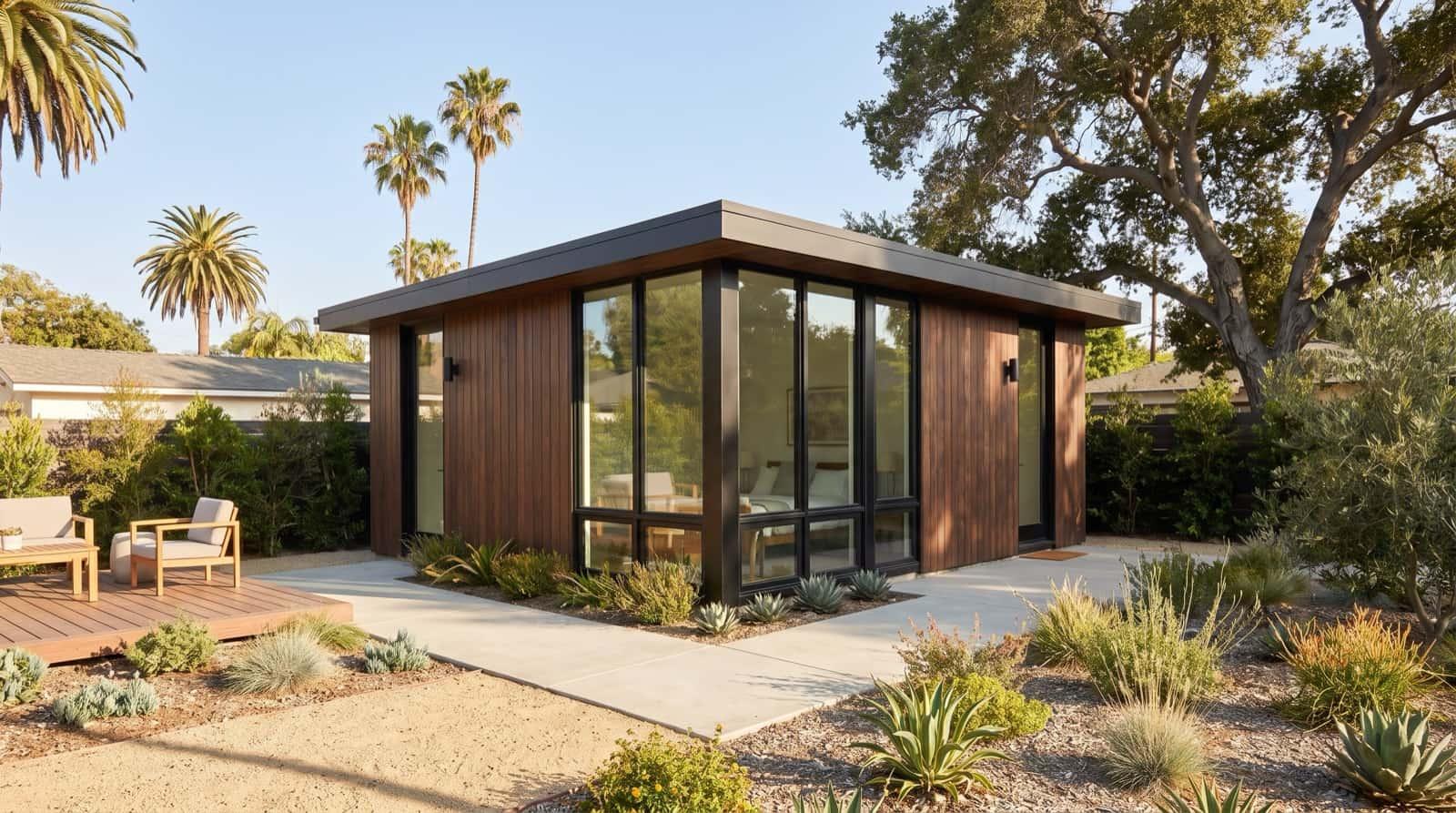
The city recognizes three broad paths. A detached ADU is a standalone structure in your yard. An attached ADU shares a wall with the main house. A conversion ADU turns existing space, most often a garage, into a legal dwelling. There's also the JADU (junior ADU): up to 500 sq ft carved out of the existing home, which can share a bathroom with the main house. Many LA lots can legally add both one ADU and one JADU, which is why you'll see homes with a converted garage unit plus a small in-house junior unit.
Size limits
State law guarantees you can build at least an 800 sq ft ADU regardless of local lot-coverage or floor-area rules. Above that floor, the ceiling depends on the type: detached ADUs are commonly capped around 1,200 sq ft, and attached ADUs are limited to a percentage of the existing home's floor area (with the 800 sq ft guarantee still protected). A conversion has no size cap beyond the footprint of the existing structure, a 400 sq ft garage becomes a 400 sq ft unit. If you want a two-bedroom rental, a detached build is usually the path; if budget is tight, a garage conversion gets you a legal unit for far less.
Setbacks, height, and parking
- Setbacks: State law caps side and rear setbacks at 4 feet for new detached ADUs, LA cannot require more. Converting an existing garage that already sits on the property line requires no added setback.
- Height: Detached ADUs can generally go to 16 feet, and up to 18-25 feet in specific cases (near transit, or to match a two-story main house), enabling above-garage units.
- Parking: This is the big one. LA cannot require replacement parking for an ADU within a half-mile of public transit, which covers most of the city. Converting your garage almost never triggers a requirement to rebuild the parking you lost.
That parking exemption is what makes garage conversions the single most popular ADU in Los Angeles: you reuse a structure you already own, on a footprint that's already there, without surrendering a parking space.
Permits and timeline
ADUs are ministerial in California, meaning the city must approve a complete, code-compliant application without a public hearing or neighborhood discretion. By law, LA's Department of Building and Safety must act on your application within 60 days of a complete submittal. In practice, the real timeline is driven by how fast your plans are drawn and how clean the submittal is. A realistic schedule looks like this:
- Design & plans: 3-6 weeks to produce architectural and structural drawings.
- Plan check & permit: 4-8 weeks, faster if you use LA's pre-approved standard ADU plans.
- Construction: 4-6 months for a detached build; 2-4 months for a garage conversion.
Budget six to nine months from first sketch to move-in for a ground-up detached unit, and often less for a conversion. Utilities matter too: LA cannot require a new, separate water or sewer connection for an ADU converted within an existing structure, which saves both time and thousands of dollars.
Common mistakes that stall LA ADU projects
- Assuming your garage is buildable as-is, many lack the foundation depth, ceiling height, or drainage a legal dwelling requires.
- Skipping Title 24 energy compliance, which every new conditioned space in California must meet.
- Ignoring sewer capacity and electrical panel size, a common surprise cost on older LA homes with 100-amp service.
- Hiring a designer who doesn't build; permit-ready plans and buildable plans are not the same thing.
Why homeowners build ADUs
The math is straightforward in most of LA: a well-built ADU rents at a strong monthly rate, adds appraised value to the property, and gives families flexible space for aging parents, adult kids, or a home office. Because the rules are now by-right, the project risk is lower than almost any other addition you can make to a single-family lot. The variable that decides whether it pencils out is build cost and quality, which is entirely in your control when you choose the right contractor.
Oran Remodeling has built and converted units across the San Fernando Valley and greater Los Angeles for over 35 years. We handle the full path, feasibility, design, permits, and construction, under one roof, so the rules above become our problem to solve, not yours.


