What Is an ADU? A Plain-English Guide for LA Homeowners

If you own a home in Los Angeles, you've probably heard the term ADU thrown around at dinner parties, in real estate listings, and in city planning debates. It stands for accessory dwelling unit, and it has quietly become one of the most powerful things a homeowner can build on an existing lot. But the acronym gets used loosely, so let's be precise: an ADU is a second, fully independent living space on the same lot as a single-family or multifamily home. Independent is the key word, it has its own kitchen, its own bathroom, its own entrance, and a place to sleep. That's what separates a true ADU from a converted den, a finished basement, or a bonus room.
What makes a space a legal ADU
A room isn't an ADU just because someone lives in it. To count as a legal accessory dwelling unit in California, the space has to be permitted as one and has to include the basic ingredients of a standalone home. In practical terms, that means four things:
- A kitchen, even a compact one, with a sink, cooking appliance, and counter space.
- A full bathroom with a toilet, sink, and shower or tub.
- A dedicated sleeping and living area.
- Its own private entrance, separate from the main house.
Those four elements are what let an ADU function as a real home: someone can live there permanently, and you can legally rent it out. A guest room with a bed but no kitchen is not an ADU. A converted garage with a bathroom but no cooking facilities is not an ADU. Getting these basics right is also what makes the unit appraise and rent as separate square footage rather than as a bonus space nobody counts.
The four types of ADU
Los Angeles homeowners generally build one of four kinds of unit. Each has a different cost, footprint, and best-use case.
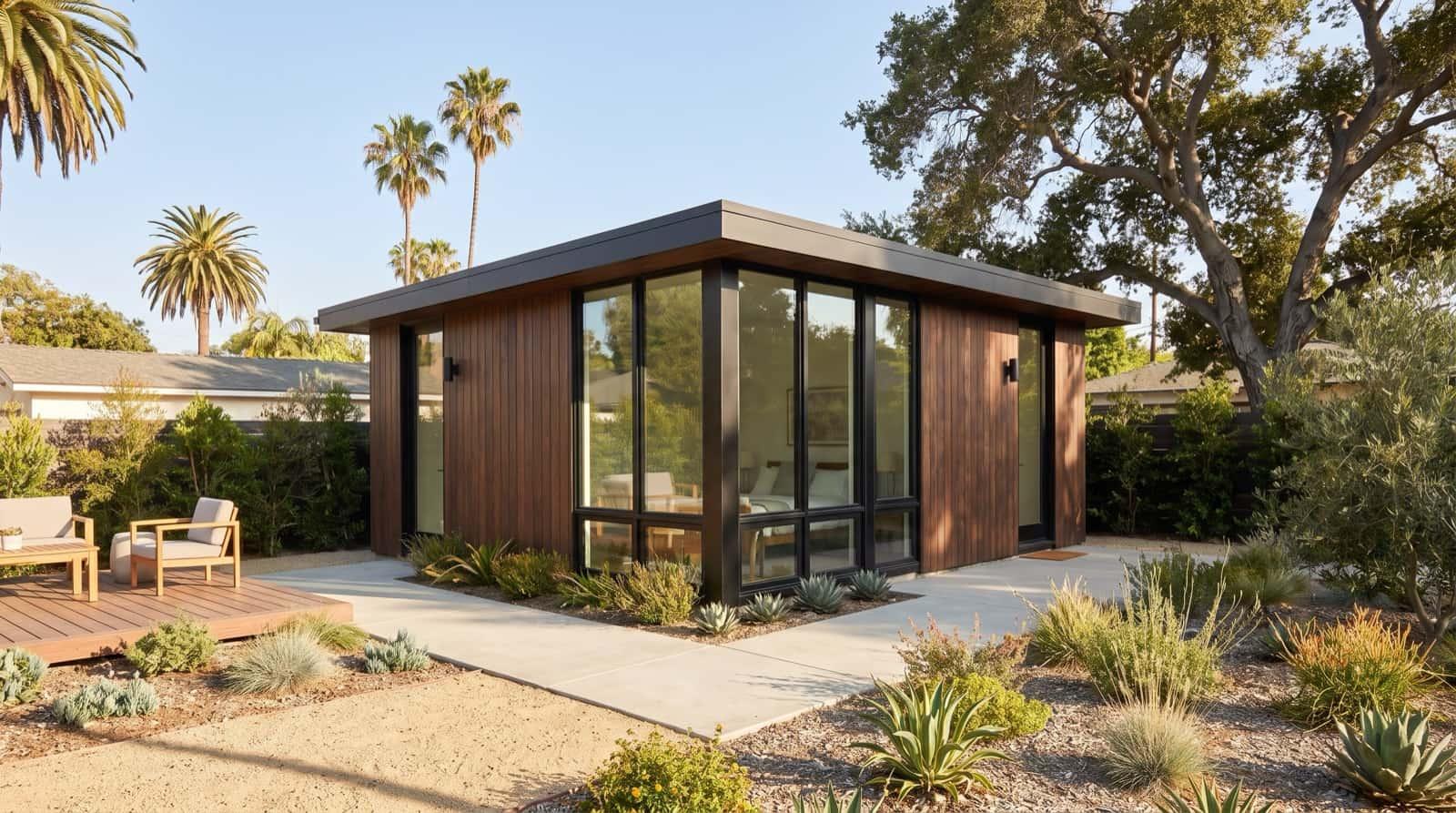
- Detached ADU: a standalone structure built in the yard, usually the backyard. It offers the most privacy and design freedom and typically commands the highest rent, but it's the most expensive to build because you're starting from an empty foundation.
- Attached ADU: a new unit that shares at least one wall with the main house, like an addition off the back or side. It can be cheaper than a detached build because it borrows an existing wall and utility runs.
- Conversion ADU: existing space turned into a legal unit, most often a garage, but also a basement or a large storage room. This is usually the least expensive path because the structure already exists.
- Junior ADU (JADU): up to 500 sq ft carved out of the existing home, often a converted bedroom. A JADU can share a bathroom with the main house and is the smallest and cheapest option.
One detail worth knowing: many Los Angeles single-family lots can legally have both one ADU and one JADU at the same time. That's why you'll see homes with a converted garage unit out back plus a small junior unit inside the main house, two rental spaces on one lot.
Why LA homeowners are building ADUs
The surge in ADUs across the San Fernando Valley and greater Los Angeles isn't a fad, it's a response to how the rules changed and how expensive housing became. Since 2020, California has rewritten its ADU laws repeatedly to force cities to approve these units quickly and by-right, stripping away the discretionary hurdles that used to kill backyard projects. That legal shift turned ADUs from a gamble into one of the lowest-risk ways to add value to a property. Homeowners build them for a handful of very practical reasons:
- Rental income: a well-built ADU generates strong monthly rent in most LA neighborhoods, often covering a meaningful chunk of a mortgage.
- Multigenerational living: a private, dignified space for aging parents or adult children who can't afford their own place in LA's market.
- Added property value: a legal, permitted unit adds appraised square footage and makes the property more attractive to future buyers.
- Flexibility: what starts as a home office or gym can become a rental or an in-law suite as your needs change.
Because the approval process is now ministerial, meaning the city must approve a complete, code-compliant application within 60 days, with no public hearing, the biggest variables left are cost and build quality. And those are entirely in your control when you choose the right builder.
What an ADU is not
A quick reality check saves a lot of disappointment. An ADU is not a tiny home on wheels, those are rarely permittable as a permanent dwelling in LA. It's not an unpermitted garage apartment your uncle built in 1985; that's a liability, not an asset, until it's brought to code. And it's not a way to dodge building standards: every new ADU has to meet California's Title 24 energy rules, fire and egress codes, and health-and-safety requirements. Done right, though, it's the single most flexible improvement you can make to an LA property.
Oran Remodeling has designed, built, and converted ADUs across Los Angeles and the San Fernando Valley for more than 35 years. We handle the whole path, feasibility, design, permits, and construction, under one roof, with in-house crews and fixed itemized pricing, so you know exactly what your unit will cost before we break ground.